Our Clockify alternative: Sheet Happens
Rollout IT was paying €2,215 a year for 37 seats on Clockify. In August 2026, our senior engineers built a focused Clockify alternative in three weeks between client projects. After migrating the data and running both systems in parallel, we cancelled the subscription and moved our team to Sheet Happens. This page shows the invoice, the scope, the trade-offs and the product as it runs today.
- Live in Rollout IT
- Since August 2026
- Built in 3 weeks
- By our senior engineers
- First-party proof
- Invoice, build log and live product
Our Clockify bill was manageable. The model was the problem
At 37 seats, Clockify cost €2,215 a year. Each new colleague added another recurring charge, while the approvals workflow sat behind a paid upgrade. We also used a separate free tool for subcontractor invoicing, which meant another login and another disconnected process. The total was not catastrophic. It was simply a bill designed to grow with our headcount.
Because the invoicing tool was free, bringing it into Sheet Happens improved the workflow but did not create a cash saving. We exclude it from the financial comparison.
- Time tracking, 37 licensed seats
- €2,215 / year
- Cost per additional seat
- ≈€60 / year
- Separate invoicing tool
- €0, plus another workflow
- Subscription cancelled
- 11 August 2026
Unseated asks growing teams to question per-seat software. Before we made that case to anyone else, we needed to prove that we were willing to make the same decision ourselves.
Three weeks later, our Clockify alternative was built around the way our team works
There was no protected roadmap or dedicated launch team behind this build. Senior engineers created Sheet Happens during available capacity between client engagements. They focused on the workflows our team relied on every week, migrated the data, ran both systems in parallel and then switched the subscription off. What they built is the live product our team uses today, not a concept treatment or polished mockup.
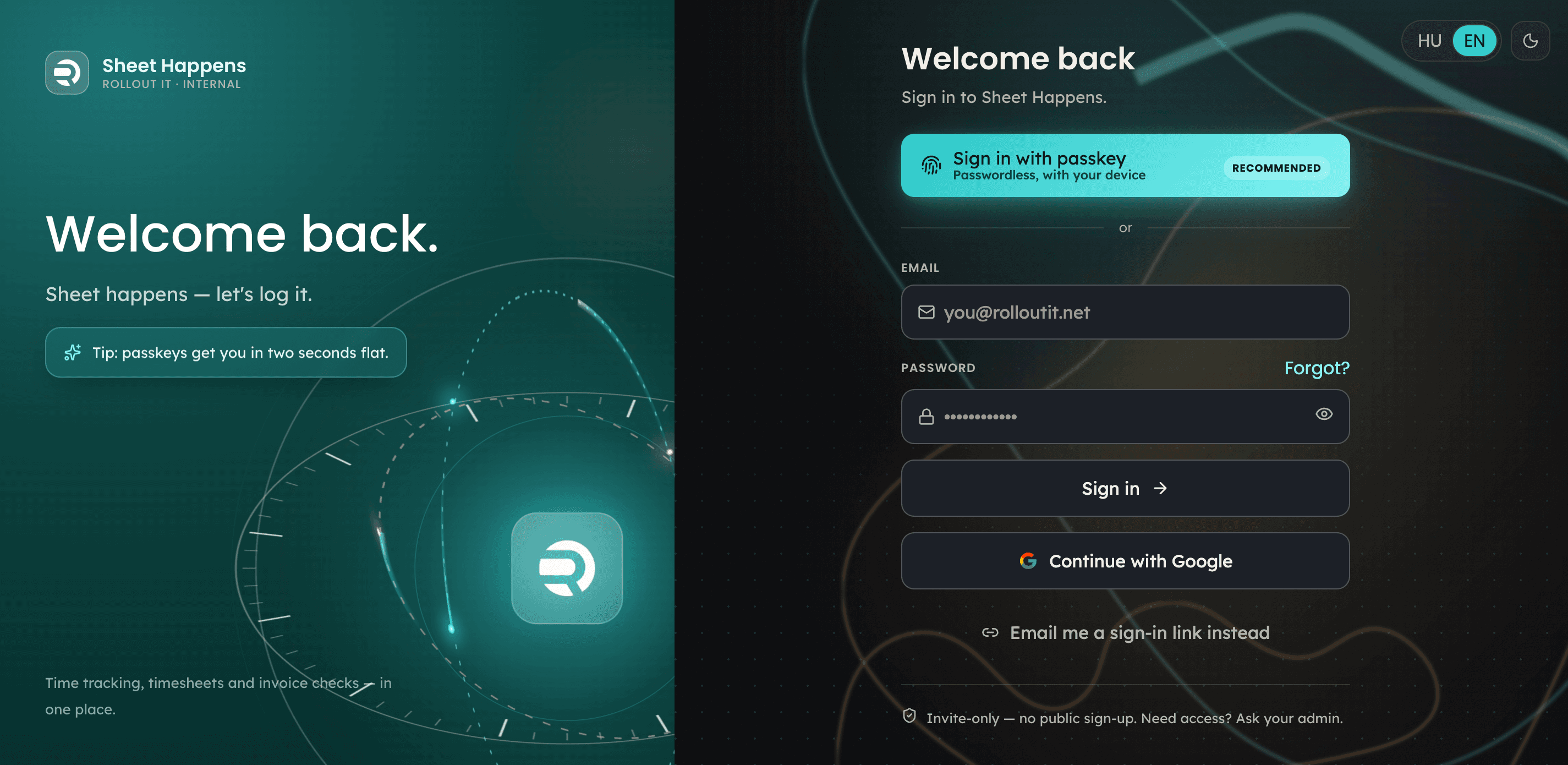
The workflows we relied on, plus two the old setup could not give us
Sheet Happens now handles weekly time entry, project allocation, approvals, reporting and exports across Rollout IT. It also gives colleagues payslip self-service and brings subcontractor invoicing into the same system. Those additions remove manual handoffs and separate logins, without another paid upgrade.
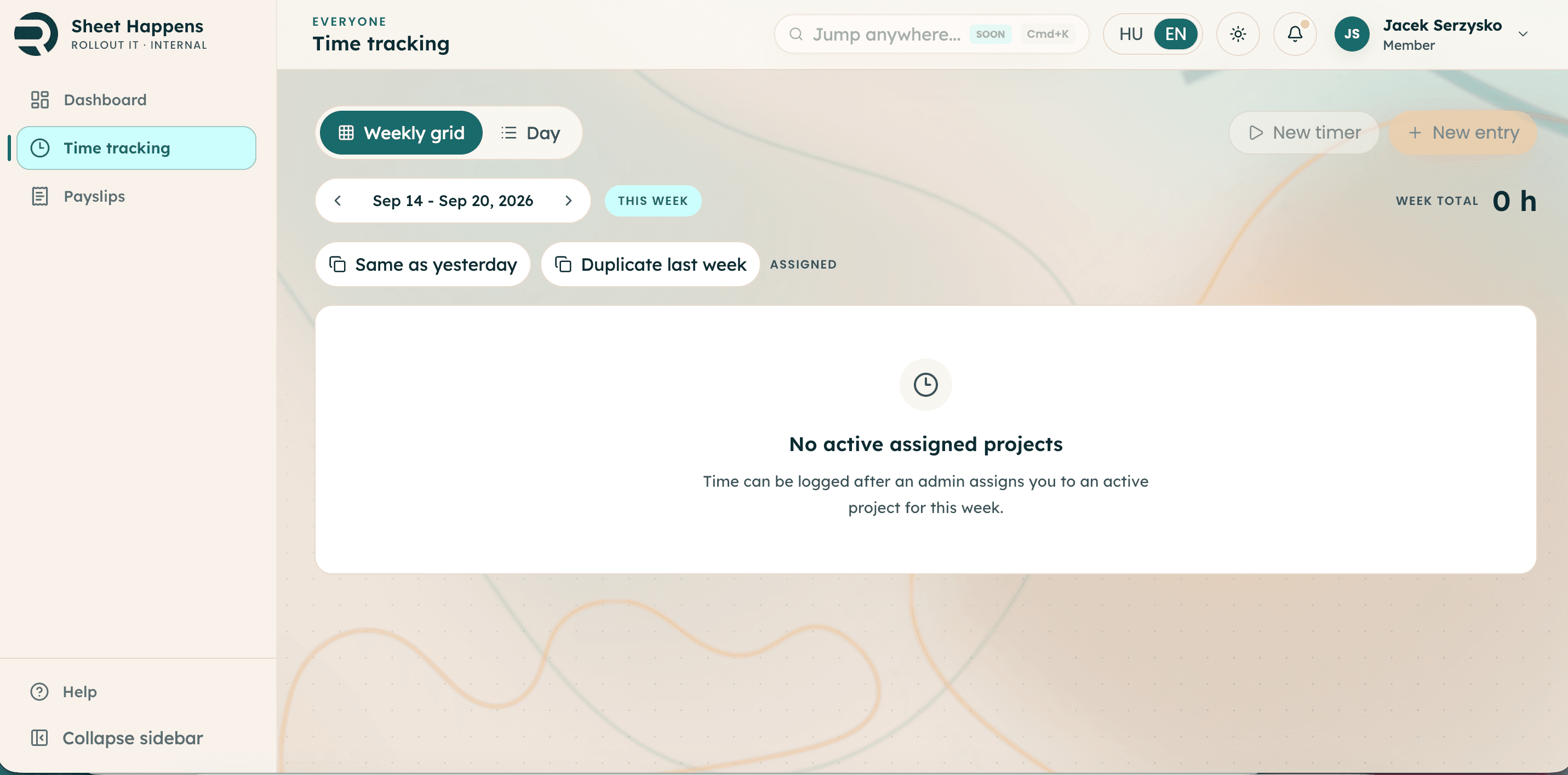
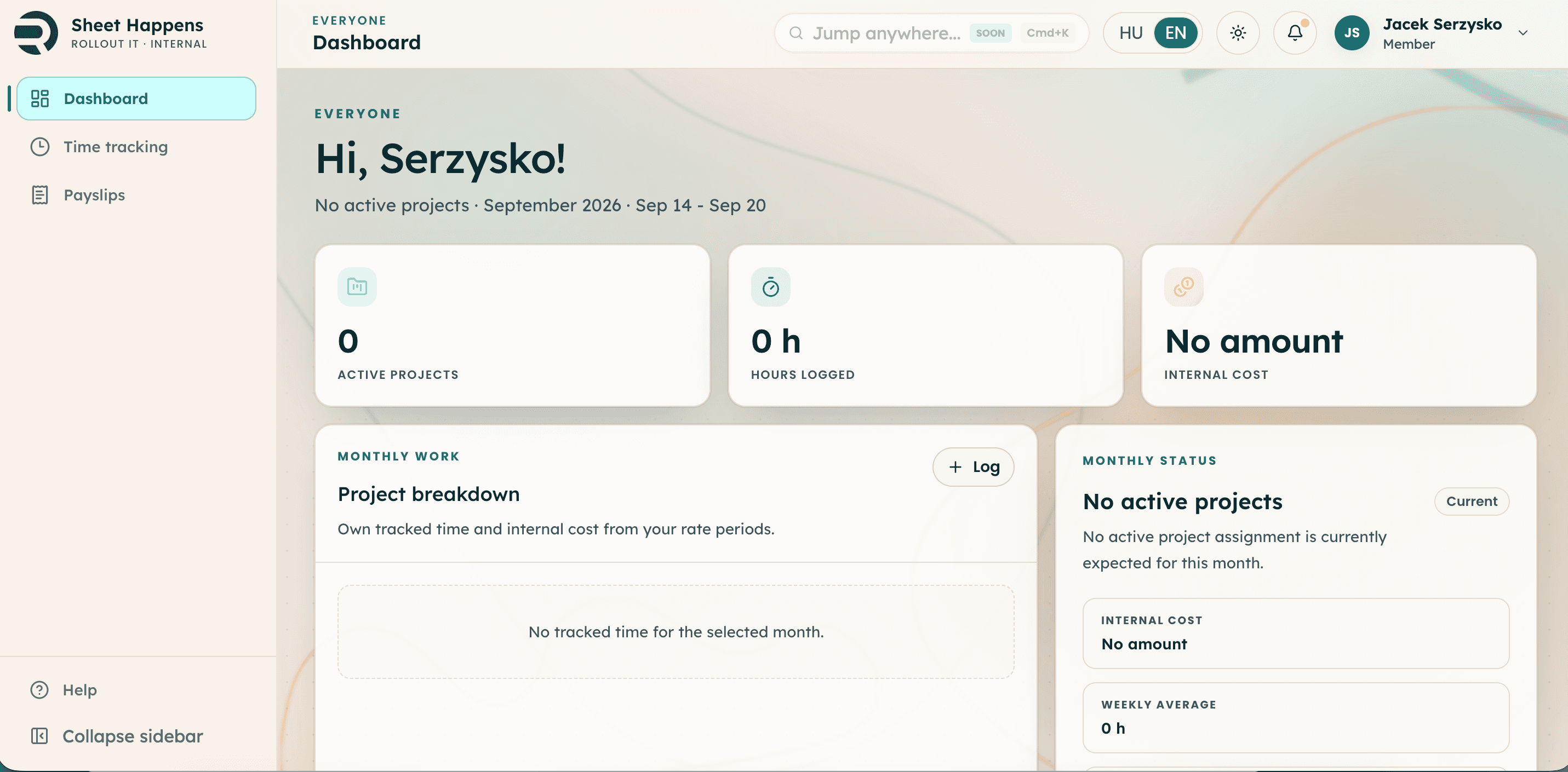
| Previous setup | Sheet Happens | |
|---|---|---|
| Annual subscription at 37 seats | €2,215 / year, rising with headcount | Flat operating model, no seat charges |
| Approval workflow | €888 / year paid upgrade | Built into the core workflow |
| Payslip self-service | Not available on any plan | Included for our team |
| Seat fee for each new colleague | ≈€60 / year | €0 in additional licence fees |
First-party sources: Rollout IT's subscription invoice and Sheet Happens build log, checked in September 2026.
We rebuilt 4 of 16 modules. Leaving 12 out was a deliberate decision
Feature-for-feature cloning would have added cost without improving our day-to-day work. We rebuilt the four modules our team used, left twelve untouched and avoided spending engineering time on features that had no value for us. That discipline keeps a focused build practical, maintainable and worth the investment.
A per-seat bill rises with the team
Our invoice gives us one verified point: 37 seats cost €2,215 a year, or roughly €60 per seat. The second line is deliberately labelled as a model. It uses the €2,500 annual operating assumption from the public calculator because Sheet Happens' internal running cost is not part of this case study. The comparison shows the shape of the two models, not a fabricated saving.
Fewer than about 30 seats? We would usually tell you to keep the SaaS
Unseated is designed for simple, expensive tools with enough users or annual spend to justify a focused rebuild. Around 30 seats is where we would start the conversation and model the full economics. That threshold signals when the numbers deserve a closer look; it does not guarantee that every project breaks even there. Below it, the subscription often remains the more sensible choice. The calculator gives you a first pass, while a proper scope decides the answer.
The replacement became a foundation for the next internal workflow
With time tracking running, Sheet Happens can grow into the adjacent processes we actually need: onboarding, internal training and a shared company knowledge base. We can add those capabilities to the same isolated system without buying another licence for every colleague. The roadmap follows our operation, not a vendor's packaging.
Proof matters most when it includes the uncomfortable details
Yes. We ran both systems in parallel for about two weeks in August 2026 while July's data was migrated. We then cancelled the subscription, and Sheet Happens became our time-tracking system.
Start with the maths, before you start a sales conversation
Enter the tool, seat count and price you pay. In about two minutes, you will see whether a replacement deserves a closer look, or whether you should keep the subscription.